






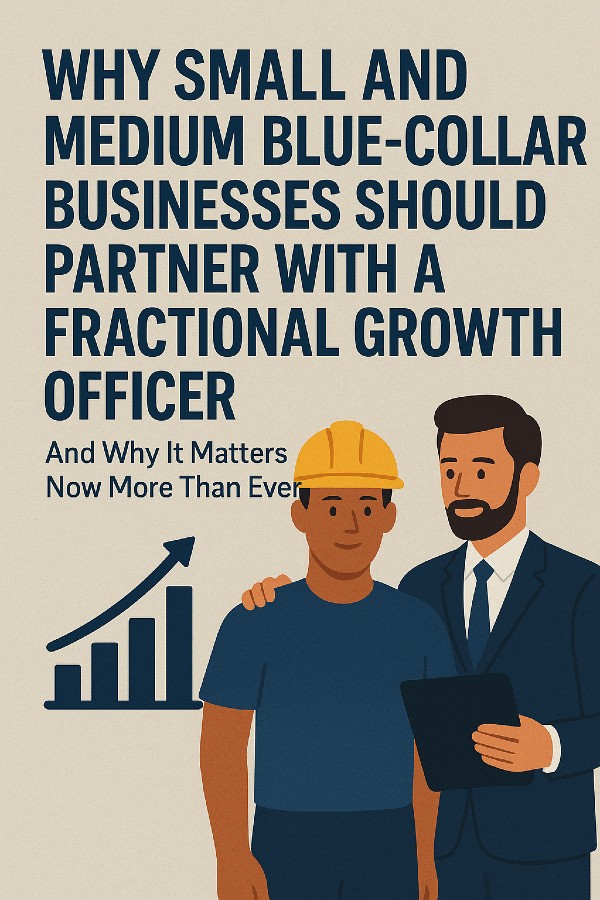

Why Small and Medium Blue-Collar Businesses Should Partner with a Fractional Growth Officer
And Why It Matters Now More Than Ever
Small to mid-sized blue-collar enterprises, whether manufacturing shops, production facilities, construction trades, warehousing/distribution operations or industrial services, face unique growth and leadership challenges.
Many founders and owners are domain experts in their trade, but may not have the full leadership structure, growth strategy, or aligned culture needed to scale sustainably.
That’s where a fractional growth officer can make a profound difference.
1. Blue-Collar Leadership Is Different – And Many Businesses Are Underequipped
The blue-collar world comes with pressures and realities that simply don’t show up the same way in white-collar/service businesses:
- High-volume, physically demanding work. Safety, equipment, shift work, varied worker backgrounds are part of the mix.
- A workforce that may speak a “different language” than executives and managers with a white-collar background. As Jeremy L. Davis puts it: “Executives, managers and supervisors … can’t successfully lead in unison because they literally speak different languages since they aren’t following the same training protocols.”
- High turnover, low morale, absenteeism, quiet quitting, customer‐service failures and lost profit are real threats when leadership and culture don’t align with the operational reality.
- The skills to lead, not just manage, are critical: Bbridging the gap from the boardroom or front-office strategy to the shop floor.
For many small and medium blue-collar firms, the growth barrier isn’t a lack of demand or opportunity—it’s the leadership, alignment, systems and culture needed to scale, improve retention, increase productivity and embed growth.
2. What a Fractional Growth Officer Brings
As you position yourself in this role, you bring a unique combination: operational blue-collar experience + growth mindset + strategic leadership. Here are how your specialties can map to key business needs:
- Operational fluency: You understand the realities of blue-collar operations – production floors, safety protocols, shift teams, diverse worker backgrounds. Much like Jeremy L. Davis, who cites 25 + years leading in steel processing, production, warehouse, distribution, etc.
- Leadership alignment: You help bridge the language and priorities between owners/executives and frontline teams. You build unified leadership so that strategy is executed, not just planned.
- Growth systems: You introduce frameworks for leadership development (e.g., micro-training, consistent leadership messaging, KPI alignment) that scale with the business. For example, Jeremy’s “Bridge Leadership” uses 20-minute micro-lessons delivered weekly to ensure all leaders are aligned.
- Retention and culture improvement: You tackle one of the biggest drags on growth in blue-collar – turnover, disengagement, safety issues – by elevating leadership, communication, and culture.
- Strategic growth mindset: Beyond operations, you help the business clarify its growth vision: market expansion, new services, higher margin work, talent pipelines, leadership bench strength.
In short: As the Fractional Growth Office I will be the growth lever – not just someone to come in and execute a one-off project, but someone who becomes a part-time, high-impact leadership partner while the business retains control and keeps costs sensible.
3. Why Small and Medium Businesses Should Invest Now
Here’s why now is a particularly good time for small and medium blue-collar firms to engage a fractional growth officer:
- Labor dynamics: With tightening labor markets for blue-collar skills, retention and leadership become even more critical. If you cannot keep your people, growth stalls.
- Scaling complexity: As you grow – from one plant to multiple shifts, from small team to larger crew – systems that worked when small break down. Without stronger leadership and process, chaos creeps in.
- Competitive differentiation: Many blue-collar firms still lag in leadership development and culture. By getting ahead you can gain an edge: lower turnover, higher productivity, better customer service.
- Strategic capacity without full-time cost: As a fractional growth officer, you offer high-value expertise without requiring a full‐time salary or long ramp time. That makes it accessible to smaller firms.
- Return on investment: Improved leadership, reduced turnover, better safety, higher productivity—these aren’t just “nice to have”, they directly impact the bottom line. Industry insight suggests leadership training in blue-collar contexts is a profit center (not just cost). (Blue-Collar Today)
4. How You Can Work With Blue-Collar SMEs
Here’s a suggested roadmap you could present to prospective clients:
- Discovery and diagnostic – Assess the leadership alignment, culture, turnover, productivity, safety, strategic vision.
- Roadmap & priority setting – Identify the highest-impact lever(s) for growth: e.g., leadership training rollout, retention strategy, process alignments, market growth plan.
- Implementation in fractional mode – You serve as part-time growth officer: executive coaching, leadership micro-training design and rollout, strategy workshops, align metrics, mentor key managers.
- Monitor and adjust – Track key performance indicators (turnover, absenteeism, production output, safety incidents, revenue growth), adjust the course.
- Hand-off and embed – Build internal capability so that the business can sustain the improvements and continue growth beyond your engagement.
By positioning yourself this way, you address not just a niche “leadership training” role, but a strategic growth partner for blue-collar businesses.
5. What Makes You Different (and Why Clients Should Care)
When pitching this role to blue-collar SMEs, emphasize what sets you apart:
- Deep blue-collar industry experience – You speak the language and understand the context (like Jeremy does).
- Growth mindset + leadership system expertise – You don’t just train; you build scalable systems (micro trainings, leadership alignment, tactical execution).
- Affordable fractional model – You know how smaller firms need high-impact leadership input without the price tag of a full-time exec.
- Focus on measurable outcomes – You link leadership and culture interventions to tangible KPIs (turnover, morale, productivity, safety, growth).
- Hands-on, not theoretical – You bring belief that leadership happens “in the trenches” and not just at strategy sessions. (Just as Jeremy writes: “The ultimate boss move isn’t power. It’s presence.”) (thejeremyldavis.com)
Final Thoughts
For small and medium blue-collar companies, the growth ceiling is often not external market demand—it’s internal capacity: leadership, alignment, culture, systems. By stepping in as a fractional growth officer, you enable these businesses to “punch above their size”: to retain key people, align leadership, increase productivity, deliver quality, and grow sustainably.